Sunday, 5 August 2012

Bella's Animal Olympics - running

Hi

There are many running events in the Olympics but they can be divided into two categories, sprinting and endurance. Sprinting takes place over a short distance because fast speeds are difficult to maintain over a long distance while endurance is all about keeping going over a long distance.

For gold position for sprinting has to go to the cheetah reaching speeds of 70 mph.
The cheetah can only keep this speed up for a few hundred meters and then they give up the chase because they would use more energy than they would replace by eating their prey.

Of course a meal is a great incentive to break a record.

The fastest flightless bird is the ostrich reaching speeds of 43 mph.

Endurance running takes place over much longer distances. The fastest land animal long distance is the Pronghorn or American Antelope running at 35 mph for 4 hours.

Two red wolves were recorded to have run for 2 weeks straight without stopping.

 Wow.

More Animal Olympics soon

Bella

Friday, 3 August 2012

Bella's Animal Olympics - Weight Lifting

Hello

The next Olympic challenge is weight lifting.

An ant can lift 20 to 50 times its own body weight. If this was a human at the Olympics they would be weight lifting with cars and other vehicles.
Leaf cutter ants
However an ant could not grow as big as a human because ants breathe through special holes in their body, a system that only works with very small creatures. Although in prehistoric times when there was much more oxygen in the air, insects could grow very big and dragonflies were as big as a hawk.

The ant’s secret is that they have 6 legs and that three legs are always on the ground, making the most stable shape a tripod. Human weight lifters only have two legs and this makes them very top heavy and unstable when they lift those heavy weights – so for humans they do amazingly well too.

The weaver ant would win the gold medal being able to carry weights 100 times its own body weight.

Phew, that’s amazing. It makes me feel exhausted just thinking about it.

More olympic facts soon.
In the meantime, why not check out your garden and see if you can see any ants. They really are fascinating. Ants are hunters, scavengers, farmers, follow trails made from their own scent and live in a nest which is usually underground and ruled by a queen.

Bella Bear

Thursday, 2 August 2012

Bella's Animal Olympics - high jump

Hi everyone

I hope you are all enjoying watching the 'human' Olympic Games. This got me thinking about what animals would be he best if there was an animal oympic games. Lets start with the high jump. For its size, the animal olympic champion would be a small bug called a froghopper.

The froghopper is also known as a spit bug. You can often see the frothy blobs on plants in your garden at this time of the year. Hidden inside the blob is a young froghopper sucking the juices from the plant.
Adult froghoppers are tiny, about 6 mm long. These bugs can leap an amazing 70cm high. That's about the same as a human jumping over a 210 metre high sky-scraper.
So for its body size, the froghopper bug would win the gold medal. The flea once thought to be the highest leaper for its size has been relegated to silver position with an impressive 18cm leap.

Have a look in your garden and see if you can find any froghoppers or their frothy blobs.

More animal olympic champions soon.

Monday, 11 June 2012

Lewes Railway Land Nature Reserve 25th Anniversary part 2

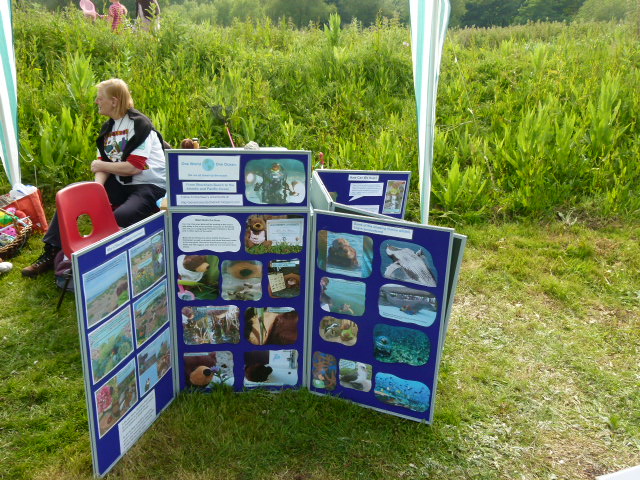
There were lots of interested people visiting our stand and were enjoying finding out about Ed the Bears adventures.
I also gave out leaflets for Shoreham Beach Local Nature Reserve to encourage people to visit. The shingle plants are spectacular at this time of the year.

The visitors also learned about some of my adventures too.
You can see the badge I was given when I helped run some events in the Biscayne National Park in Florida USA during their family fun fest. I also helped out with their bioblitz event, the aim was to record as many different animals in 24 hours. This included staff and visitors.

Soon it was time for the next bug hunt and another group of children and adults. Again, after telling them all about Ed the Bear and also my work with freshwater habitats, we left for the bug hunt.

We went a different way around the Heart of Reeds this time. I loved crossing over the boardwalk section.

Again, we found lots of bees and also some red admiral butterflies that were resting on the path.

The children particularly liked the snails.
There are several different colour varieties of the white-lipped banded snail.


Some were even yellow with no bands.

There were lots of ladybirds again
.


One of the children carried me around for part of the walk to give my little legs a rest.

Two mallard ducks flew overhead

We also saw some warblers.
These small brown birds build their nest on the stems of the reeds where it is difficult for predators to find them.

At the far end of the Heart of Reeds we stopped again to look at the Winterbourne Stream.
We saw this beautiful blue damselfly resting on the vegetation.
If it wasn't so windy, we probably would have seen more damselflies and maybe even dragonflies.
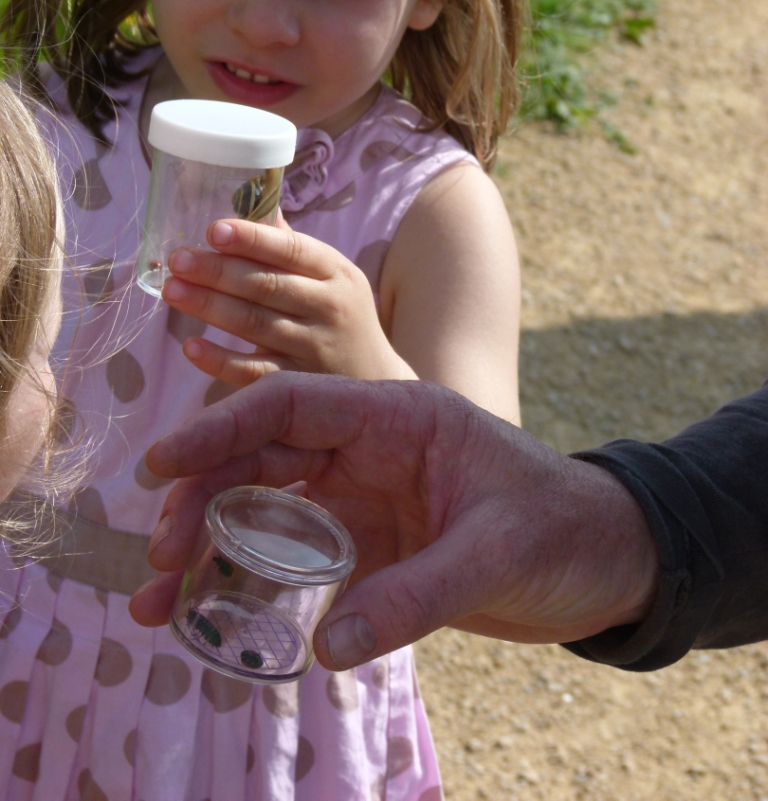
We had a look at the creatures the children had collected in their bug pots before releasing them again. We saw lots of fascinating creatures and the children and adults had lots of questions.

Wow, what a fun day. I hope I get the chance to come back and explore more of the Railway Land Nature Reserve.

Bye for now

Bella.


Sunday, 10 June 2012

Lewes Railway Land Nature Reserve 25th Anniversary Event, part 1

Hello

I have not reported for sometime on my weblog. I hve been helping my brother Ed the Bear to plan his adventures. As you may know, from time to time I travel to sites and events that Ed the Bear cannot visit because he is travelling somewhere else.

Well, Ed the Bear was invited to share his adventures at the Lewes Railway Land Nature Reserve 25th Anniversary Event.
Ed the Bear is at the National Black Scuba Divers Youth Summit, which includes the Tennessee Aquatic project Ed visits each year. The project teaches youths of 8-18 years who are at risk or underprivlaged to scuba dive and teaches other life skills.

Ed always visits the Youth Summit, so he asked me if I would go to Lewes instead. I was delighted, because while Ed the Bear has a passion for the ocean, I am more interested in ponds and land animals such as birds and insects.

I was asked if I would lead 2 bug hunts around an area called the heart of reeds. This is a special reed bed that was designed by the environmental artists Chris Drury.

The heart of reeds is designed to represent a cross section of a heart - the water representing the blood flow through the heart.
I came with Ed's friend Steve and we brought Ed's display so we could share Ed's the Bears story and message. We set up the display in a tent.
It wasn't long before it was time to run the first bug hunt for a group of children and adults.  We went to the top of the mound which over looked the heart of reeds. We spoke to the group about the reed bed and the wildlife we hoped to see. We then started our bug hunt around the heart of reeds.

I warned the children that the water was very deep and that they needed to stay near the path.

There were many spiky teasels and we told the group about how rainwater collectes in the petals at the bottom of the head.

Small insects drown in this and as they decompose the plant can absorb their nutrients.

We saw lots of wildlife as we went around the trail. There were lots of different beetles (black and a green one) and also many ladybirds. There were black ants guarding blackfly, these little black bugs suck the juices from plants.

Ladybirds eat black fly and ants tb to stop them because the ants farm the blackfly to get a sugary liquid from them which the ants like. We also saw differnt types of woodlice, inckuding the pill bug which can role up into a ball to defend itself.
The children had bug collecting pots and they collected some of the animals they found so we could have a closer look.

As we walked around we saw lots of bees, including honey bee, buff tailed bumble bees and red tailed bumble bees.

We saw this female spider carring her eggs. We decided it would best to leave her where she was so as not to disturb her.

The children found lots of banded snails. Steve told the group that snails were  very important. Firstly because other animals eat them and Steve asked the children if they could think of an animal that eat snails. One child said a thush and another child said hedgehogs.

Steve said snails were important because when they eat plants they open up space for other plants to grow. Its only in our gardens that some people  think of them as pests.

We watched this beautiful male mallard duck.
Only the males are brightly coloured, the females are brown so that predators cant spot them while they were on the nest.
When we had finished the walk, we released the animals back into the heart of reeds where they live.

Everyone said they enjoyed bugwalk and learned lots of interesting things.

I will tell you about the second bug hunt later.

Bye for now, Bella.

Thursday, 12 August 2010

More National Whale and Dolphin Watch

I have had a great time at National Whale and Dolphin Watch in Cardigan Bay.

We raised lots of awareness of whales and dolphins around our coast.
We had fun too.

We even saw dolphins.

Tuesday, 10 August 2010

Helping count whales and dolphins with the Sea Watch Foundation

Hello

I have been such a busy bee this summer. Even though I am a little envious of my Brother Ed’s foreign adventures, I've had the lovely opportunity to spend most of the summer in New Quay, West Wales working as a volunteer for the Sea Watch Foundation.

The Sea Watch Foundation is a national marine conservation research charity that protects the whales, dolphins and porpoises (cetaceans) around the UK. You might be surprised to know that 26 different types have been recorded around the UK, 13 species are seen regularly. Much of the research that Sea Watch does is carried out on the resident bottlenose dolphin population here in Cardigan Bay. Over the last ten years they have recorded over 230 individual dolphins. This information has helped to set up the two Special Areas of Conservation in Cardigan Bay. These are protected areas for the bottlenose dolphins and harbour porpoises.

Bottlenose dolphins

Harbour porpoise

I arrived in New Quay at the beginning of August to help out with the National Whale and Dolphin Watch week. The watch is an opportunity for members of the public to take part, in looking out for dolphin, whales and porpoises around the coast of the United Kingdom. A great idea - giving people the chance to get involved in the research which goes into understanding these magnificent creatures. The results collected during the watch provide a snapshot of where different species are around the British Isles. This information helps to inform scientific discussion on any change in the range and distribution of species. 


The National Whale and Dolphin Watch week ran from the 7th - 15th August this year. It was quite windy and rough for a lot of the week here in New Quay, but that didn’t stop me and the team of hard working Sea Watch volunteers from having an amazing time. During the week there were manned land watches taking place across the UK. I know my brother Ed will be helping out at one of the watches on his beach down in Shoreham in Sussex.


You can find out more about Ed the Bear's NWDW by clicking te link below


We also had a dedicated team on the pier here, which juts out into New Quay Harbour.


New Quay harbour is a great easily accessible location to see the bottlenose dolphins in their natural habitat. Because it's shallow and sheltered the dolphins love to come in and feed on the pollack, bream, turbot and  flounder along with other species of fish.