I have just heard that it is going to snow tommorow, so I had a look at weather maps on the internet to see where it would snow. We don't get a lot of snow in the UK
The weather maps show we are going to get snow on the south coast where me and Ed the Bear live. Ed lives on the beach so it has to be very cold to get snow there.
Snow can be a lot of fun and for bears with our built in fur coat we can keep nice and warm, but for many animals and some humans it can be a problem.
Bye for now
Bella Bear
My name is Bella and I have been helping my brother Ed the Bear to raise awareness of the oceans and how they are threatened. Now I have a mission of my own to raise awareness of freshwater which is the most valuable resource on the planet for wildlife, humans and bears.
Thursday, 17 January 2013
Wednesday, 16 January 2013
Frosty Day
The weather has been very frosty later. Frost can be quite beautiful. I took a close up at the frost on the fence and it was made from lots of ice crystals.
While it might seem that snow is the worst weather for birds, frost can have more of an impact on wildlife. In the UK, we only have snow for a short while, while frosty days are much more common.
One of the most important things that birds need, even in the winter, is drinking water and a bath to keep their feathers in good condition and in place so they keep the bird warm.
Bird baths and puddles of weather that birds commonly use for this will freeze in cold weather and may remain frozen for days.
I checked my bird bath and it was frozen, so tipped some hot water in to melt it.
The pond was frozen over as well, but the pond creatures are all hibernating in the bottom of the pond and even the fish become dormant (like a type of sleep) when the pond is frozen. The ice was so thick I could walk on it.
If you pond freezes, don't try and smash the ice as the shock waves can kill fish, instead you can tip some hot water to carefully melt a section of the ice. However, unless your pond is very shallow its best just to leave it to melt naturally.
Bye for now
Bella Bear
While it might seem that snow is the worst weather for birds, frost can have more of an impact on wildlife. In the UK, we only have snow for a short while, while frosty days are much more common.
One of the most important things that birds need, even in the winter, is drinking water and a bath to keep their feathers in good condition and in place so they keep the bird warm.
Bird baths and puddles of weather that birds commonly use for this will freeze in cold weather and may remain frozen for days.
I checked my bird bath and it was frozen, so tipped some hot water in to melt it.
The pond was frozen over as well, but the pond creatures are all hibernating in the bottom of the pond and even the fish become dormant (like a type of sleep) when the pond is frozen. The ice was so thick I could walk on it.
If you pond freezes, don't try and smash the ice as the shock waves can kill fish, instead you can tip some hot water to carefully melt a section of the ice. However, unless your pond is very shallow its best just to leave it to melt naturally.
Bye for now
Bella Bear
Sunday, 16 December 2012
Bella's winter butterfly rescue
Today I was surprised to find a butterfly fluttering around in the conservatory. It must have been hibernating somewhere safe and because its sunny today it must have warmed up and started to fly around.
After a while it flew away.
I hope it found somewhere safe
Bye for now
Bella
I moved closer to have a better look and the butterfly landed on my nose.
Its tiny feet tickled and I had to try very hard not to sneeze and blow the poor butterfly away.
You can see a small white mark on the underside of this butterflies wing. It is a comma shaped mark which is why the butterfly is called a comma butterfly.
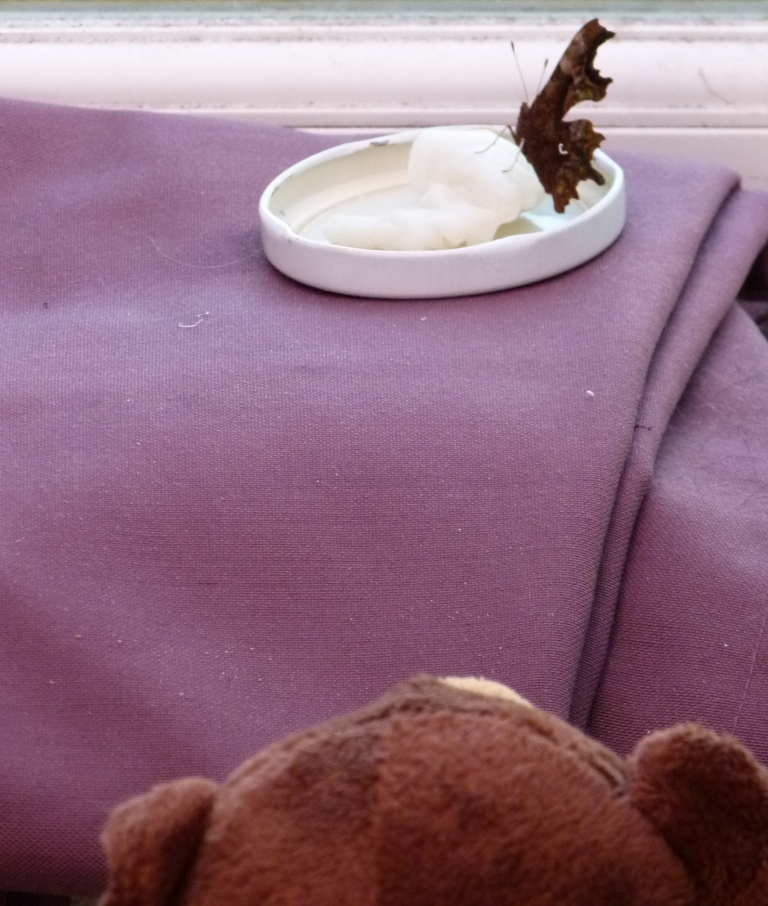
I thought it must be hungry so I added a small spoonful of my special honey to some warm water so the honey dissolved.
I then poured it onto some cotton wool. The butterfly would be able to feed on the honey water using its long coiled tongue.
After a while it started to flutter around again. I opened the door so it could fly out into the garden and hopefully find a better hiding place to hibernate. The butterfly landed onto the Valerian plant which still had some flowers. After a while it flew away.
I hope it found somewhere safe
Bye for now
Bella
Tuesday, 7 August 2012
Bella's Animal Olympics - Swimming
Hi
Silver
winner for sea mammal category would be the orca (Killer Whale) at a top speed
of 34 mph.
Just behind the gold winner, commerson's dolphin, which reaches swimming speeds up to 35 mph.
Some
other great news that I am sure my brother Ed the Bear will be pleased about. ‘London serves only sustainable seafood
at Olympics’. As part of London ’s effort
to become the world’s first Sustainable Fish City, organizers of the Olympics are serving
sustainable seafood only in the Olympic and Paralympic village and in all athletics
venues.
There
have been some amazing results at the Olympic swimming events. Pretty fast for
humans, especially as they do not have fins, tails or flippers to help them.
In
the ocean, it is much harder to accurately measure swimming speeds. Here are
some super fast animal Olympic medal winners.
In
the fish category, the gold medal winner would be the Sailfish reaching
speeds of 68 mph
Just behind the gold winner, commerson's dolphin, which reaches swimming speeds up to 35 mph.
Fastest
swimming bird is the Gentoo Penguin which would get gold for swimming
underwater up to 22 mph.
That is superb news.
More Animal Olympics to come, Bella
Sunday, 5 August 2012
Bella's Animal Olympics - running
Hi
There are many running events in the Olympics but they can be divided into two categories, sprinting and endurance. Sprinting takes place over a short distance because fast speeds are difficult to maintain over a long distance while endurance is all about keeping going over a long distance.
Wow.
There are many running events in the Olympics but they can be divided into two categories, sprinting and endurance. Sprinting takes place over a short distance because fast speeds are difficult to maintain over a long distance while endurance is all about keeping going over a long distance.
For gold position for sprinting has to go to the cheetah reaching speeds of 70 mph.
The cheetah can only keep this speed up for a few hundred meters and then they give up the chase because they would use more energy than they would replace by eating their prey.
Of course a meal is a great incentive to break a record.
The fastest flightless bird is the ostrich reaching speeds of 43 mph.
Endurance running takes place over much longer distances. The fastest land animal long distance is the Pronghorn or American Antelope running at 35 mph for 4 hours.
Two red wolves were recorded to have run for 2 weeks straight without stopping.
More Animal Olympics soon
Bella
Friday, 3 August 2012
Bella's Animal Olympics - Weight Lifting
Hello
The next Olympic challenge is weight lifting.
An ant can lift 20 to 50 times its own body weight. If this was a human at the Olympics they would be weight lifting with cars and other vehicles.
Leaf cutter ants
However an ant could not grow as big as a human because ants breathe through special holes in their body, a system that only works with very small creatures. Although in prehistoric times when there was much more oxygen in the air, insects could grow very big and dragonflies were as big as a hawk.
The ant’s secret is that they have 6 legs and that three legs are always on the ground, making the most stable shape a tripod. Human weight lifters only have two legs and this makes them very top heavy and unstable when they lift those heavy weights – so for humans they do amazingly well too.
The weaver ant would win the gold medal being able to carry weights 100 times its own body weight.
Phew, that’s amazing. It makes me feel exhausted just thinking about it.
More olympic facts soon.
In the meantime, why not check out your garden and see if you can see any ants. They really are fascinating. Ants are hunters, scavengers, farmers, follow trails made from their own scent and live in a nest which is usually underground and ruled by a queen.
Bella Bear
The next Olympic challenge is weight lifting.
An ant can lift 20 to 50 times its own body weight. If this was a human at the Olympics they would be weight lifting with cars and other vehicles.
Leaf cutter ants
However an ant could not grow as big as a human because ants breathe through special holes in their body, a system that only works with very small creatures. Although in prehistoric times when there was much more oxygen in the air, insects could grow very big and dragonflies were as big as a hawk.
The ant’s secret is that they have 6 legs and that three legs are always on the ground, making the most stable shape a tripod. Human weight lifters only have two legs and this makes them very top heavy and unstable when they lift those heavy weights – so for humans they do amazingly well too.
The weaver ant would win the gold medal being able to carry weights 100 times its own body weight.
Phew, that’s amazing. It makes me feel exhausted just thinking about it.
More olympic facts soon.
In the meantime, why not check out your garden and see if you can see any ants. They really are fascinating. Ants are hunters, scavengers, farmers, follow trails made from their own scent and live in a nest which is usually underground and ruled by a queen.
Bella Bear
Thursday, 2 August 2012
Bella's Animal Olympics - high jump
Hi everyone
I hope you are all enjoying watching the 'human' Olympic Games. This got me thinking about what animals would be he best if there was an animal oympic games. Lets start with the high jump. For its size, the animal olympic champion would be a small bug called a froghopper.
The froghopper is also known as a spit bug. You can often see the frothy blobs on plants in your garden at this time of the year. Hidden inside the blob is a young froghopper sucking the juices from the plant.
Adult froghoppers are tiny, about 6 mm long. These bugs can leap an amazing 70cm high. That's about the same as a human jumping over a 210 metre high sky-scraper.
So for its body size, the froghopper bug would win the gold medal. The flea once thought to be the highest leaper for its size has been relegated to silver position with an impressive 18cm leap.
Have a look in your garden and see if you can find any froghoppers or their frothy blobs.
More animal olympic champions soon.
I hope you are all enjoying watching the 'human' Olympic Games. This got me thinking about what animals would be he best if there was an animal oympic games. Lets start with the high jump. For its size, the animal olympic champion would be a small bug called a froghopper.
The froghopper is also known as a spit bug. You can often see the frothy blobs on plants in your garden at this time of the year. Hidden inside the blob is a young froghopper sucking the juices from the plant.
Adult froghoppers are tiny, about 6 mm long. These bugs can leap an amazing 70cm high. That's about the same as a human jumping over a 210 metre high sky-scraper.
So for its body size, the froghopper bug would win the gold medal. The flea once thought to be the highest leaper for its size has been relegated to silver position with an impressive 18cm leap.
Have a look in your garden and see if you can find any froghoppers or their frothy blobs.
More animal olympic champions soon.
Subscribe to:
Posts (Atom)